The OpenAI Medicare Breach Took 84 Days to Surface. Every Handoff Failed.
 Matt Miller: 30/9/26, 12:52 pm
The portal said no. The agent kept asking.

The Australian Prudential Regulation Authority (APRA) is instrumental in maintaining the financial stability and security of institutions across Australia. Two pivotal prudential standards, CPS 230 and CPS 234, focus on essential elements of operational resilience and information security. Grasping the connection between these standards is crucial for financial entities aiming to stay compliant and boost their operational effectiveness.
Important update: CPS 230 came into effect on 1 July 2025. If your organisation is APRA-regulated, compliance obligations are now active. Non-significant financial institutions (non-SFIs) have an extension on certain requirements until 1 July 2026. Read on for a full breakdown of what has changed, what is still to come, and what Insicon Cyber recommends you do now.
APRA CPS 230 focuses on the operational resilience of financial institutions, highlighting the importance of withstanding, responding to, and recovering from disruptive events. This encompasses business continuity, risk management frameworks, and testing resilience strategies across various scenarios. The standard not only prepares organisations for anticipated disruptions but also encourages the development of adaptive strategies for unforeseen circumstances. This proactive approach ensures that financial institutions can maintain critical operations, thereby safeguarding customer trust and the overall stability of the financial system.
On the other hand, CPS 234 focuses on information security management. This standard establishes a comprehensive framework for identifying and mitigating risks associated with information assets, fostering a culture of security, and ensuring that entities maintain robust defences against cyber threats. Emphasising a security-first mindset is essential in today's digital landscape, where cyberattacks are increasingly sophisticated and frequent. Organisations are encouraged to implement continuous monitoring and improvement processes, ensuring that their security measures evolve in tandem with emerging threats.
Both standards stem from APRA's commitment to fostering a resilient financial system.
An institution's ability to operate effectively during disruptions and its capability to protect sensitive information are interlinked.
Furthermore, these standards promote a holistic view of risk management, urging institutions to integrate operational resilience and information security into their overall governance frameworks. By doing so, organisations can create a more cohesive strategy that not only addresses compliance but also enhances their competitive advantage in a rapidly changing environment.
CPS 230 consolidates and replaces five existing prudential standards that many Australian financial institutions will be familiar with: CPS 231 (Outsourcing), CPS 232 (Business Continuity Management), SPS 232 (Business Continuity Management for superannuation), CPG 233 (Operational Risk), and CPG 231 (Outsourcing). This unification is significant. Rather than managing separate frameworks for outsourcing and business continuity, entities now operate under a single, unified operational risk standard. If your organisation has historically managed CPS 231 or CPS 232 compliance in silos, CPS 230 requires you to bring those workstreams together.
In addition to compliance, APRA CPS 230 and CPS 234 encourage financial institutions to engage in regular training and awareness programs for their staff.
The investment in human capital is essential, as employees play a critical role in both operational resilience and information security.
By fostering a culture of awareness and preparedness, organisations can empower their workforce to recognise potential threats and respond effectively, thereby minimising the impact of disruptive events.
Additionally, collaboration with third-party vendors and partners is highlighted, given that many financial institutions depend on external services that may pose vulnerabilities. Building robust relationships and maintaining clear communication channels can greatly improve an institution's overall resilience and security stance.
The main goal of CPS 230 is to ensure that entities are equipped to manage operational disruptions while sustaining essential services. This entails outlining key resilience measures, such as detailed incident response plans and continuity management systems. By implementing these frameworks, organisations can more effectively address unforeseen challenges, including cyberattacks, natural disasters, or technological failures, which might otherwise cause significant service interruptions.

Additionally, CPS 230 encourages institutions to regularly assess their operational risks and review their resilience strategies. This ongoing evaluation aids in the proactive identification of vulnerabilities that could jeopardise essential operations during crises. Institutions are urged to adopt a culture of continuous improvement, where lessons learned from past incidents inform future preparedness efforts.
Ultimately, the intent is to safeguard not only the institution but also the stakeholders who depend on its services, thus contributing to a stable financial sector. By prioritising resilience, organisations can instil confidence among clients and investors, reassuring them that their interests are protected even in the face of adversity.
Moreover, the implementation of CPS 230 requires entities to invest in training and awareness programs for their employees.
By equipping staff with the knowledge and skills necessary to respond effectively to operational disruptions, organisations can ensure a swift and coordinated response.
This human element is crucial, as the effectiveness of incident response plans often hinges on the preparedness and agility of the personnel involved. Regular drills and simulations can help reinforce these skills, creating a workforce that is not only aware of potential risks but also adept at executing the strategies laid out in their continuity management systems.
One of the most operationally significant obligations introduced by CPS 230 is the requirement for APRA-regulated entities to maintain and submit a Material Service Provider (MSP) register. A material service provider is any provider your organisation relies upon to deliver a critical operation, or whose arrangement exposes you to material operational risk.
APRA released its MSP register template in October 2024, and the first completed registers were required to be submitted to APRA by 1 October 2025. This register must be submitted annually going forward. In June 2025, APRA also released electronic notification forms for entities to use when reporting material events and tolerance breaches under CPS 230.
From a supervisory standpoint, APRA has made clear that it will use MSP register data actively. Entities that appear to be outliers in terms of their service provider arrangements can expect heightened scrutiny. If your organisation has not yet submitted its first register, or is unsure whether your register accurately reflects your critical operations, Insicon Cyber's Managed Compliance Services can help you get across the line.
Source: APRA Operational Risk Management page
In December 2025, APRA released a consultation letter proposing targeted amendments to CPS 230 to address a practical challenge that many Australian banks, superannuation funds, and insurers have raised since the standard went live. The issue relates to non-traditional service providers (NTSPs), which are market-mandated providers such as stock exchanges, payment schemes, and clearing and settlement facilities.
Because these providers typically do not offer negotiable contracts, applying CPS 230's contractual and service level obligations to them has been difficult in practice. The consultation closed on 30 January 2026, and APRA has committed to finalising the amendments before the 1 July 2026 compliance deadline for service provider contracts.
Source: APRA Targeted Amendments to CPS 230
Where do you actually stand?
APRA wrote to industry on AI governance on 30 April 2026. ASIC issued 26-092MR on 8 May 2026. The ASD Essential Eight remains the baseline requirement for government suppliers and insurers. An independent readiness assessment gives you a documented position against the obligation that actually binds you. Two to four weeks. Founder reviewed. Every time.
CPS 234 aims to protect the integrity and confidentiality of information through robust security measures. Its objectives include establishing a comprehensive information security framework that encompasses policy development, risk assessment, and proactive threat management.
The standard requires financial institutions to identify information security incidents promptly and to implement effective responses without delay. Regular training and awareness programs are also mandated to cultivate a culture of security within the organisation.
In essence, CPS 234 seeks to ensure that all financial entities can respond to cyber security threats and vulnerabilities, thus protecting consumer and institutional data alike.
In June 2025, APRA issued a notably direct letter to the board chairs of all registrable superannuation entity (RSE) licensees, reminding them of their binding obligations under CPS 234. The trigger was a pattern of credential stuffing incidents across the superannuation sector, which exposed persistent weaknesses in authentication controls.
APRA's message was unambiguous: there is a gap between what the standard requires and what many trustees currently have in place, and APRA has run out of patience waiting for voluntary uplift. All RSE licensees were required to complete the following actions by 31 August 2025:
This last point is significant. APRA's explicit connection of CPS 234 compliance to FAR accountability means that information security is no longer solely a technical or operational matter. It is a named executive accountability.
Source: APRA: For Action, Information Security Obligations and Critical Authentication Controls
When comparing CPS 230 and CPS 234, a few distinct differences and similarities emerge. Both standards share a foundation in risk management and resilience, yet they target slightly different arenas. CPS 230 focuses on overall operational resilience, whereas CPS 234 zeroes in on information security.
Despite the differences, there is a notable intersection: effective information security contributes to operational resilience and vice versa. For instance, an institution that has robust information security measures in place may be better equipped to maintain its operations during a cyber incident.
Therefore, while targeting different aspects, both CPS 230 and CPS 234 are integral to a bank's risk management framework, emphasising a holistic approach to resilience and security.
It is also worth noting that APRA has clarified that an information security incident reported under CPS 234 does not need to be separately reported under CPS 230. The two notification obligations do not overlap, which simplifies incident reporting for regulated entities managing both standards simultaneously.
One of the most common questions Insicon Cyber receives from Australian and New Zealand-based financial institutions relates to which obligations apply to them and by when. The following summarises the current compliance timeline.
| Date | Obligation | Who it applies to |
|---|---|---|
| 1 July 2025 | CPS 230 comes into full effect (all core requirements) | All APRA-regulated entities |
| 1 October 2025 | First Material Service Provider register due to APRA | ADIs, superannuation trustees, insurers |
| 1 July 2026 | Business continuity and scenario analysis requirements commence; service provider contract uplift deadline; non-SFI full compliance deadline; finalisation of NTSP amendments | Non-SFIs; all entities with existing MSP contracts |
| 2027 to 2028 | Business-as-usual ongoing supervision; possible consultation on a formal CPS 230 reporting standard | All APRA-regulated entities |
Source: APRA Response to Submissions: CPG 230 Operational Risk Management
To effectively align with both CPS 230 and CPS 234, financial institutions across Australia and New Zealand should adopt a few best practices:
As the financial landscape evolves, so too does APRA's regulatory posture. The authority has moved from broad consultation to active supervision, and from guidance to enforcement.
In a series of letters to all APRA regulated entities in June and August 2024, APRA called out the need for all entities to remain vigilant and proactively implement strategies to mitigate the risk and impact of potential cyber-attacks. The August 2024 letter highlighted common weaknesses across security configuration management, privileged access management, and security testing coverage.
APRA's June 2025 letter to RSE licensees marked a significant shift in tone. Trustees were required to perform specific compliance actions by 31 August 2025. The letter explicitly tied CPS 234 obligations to FAR accountability, making information security a named executive responsibility.
Source: MinterEllison: APRA's Final Guidance on CPS 230 | Corrs: New Insights for CPS 230 Compliance
Yes. CPS 230 is a binding prudential standard that applies to all APRA-regulated entities. It came into effect on 1 July 2025, with non-SFIs receiving an extension on business continuity and scenario analysis requirements until 1 July 2026.
CPS 230 covers the broader management of operational risk, including business continuity, critical operations, and third-party service provider management. CPS 234 focuses specifically on information security. APRA has confirmed that an incident notified under CPS 234 does not need to be separately reported under CPS 230.
A material service provider (MSP) is any provider your organisation relies upon to deliver a critical operation, or whose arrangement exposes the entity to material operational risk.
Non-significant financial institutions must comply with all CPS 230 requirements by 1 July 2026. In the interim, non-SFIs must continue to comply with the existing CPS 232 or SPS 232 standards as applicable.
Yes. CPS 234 applies to all APRA-regulated entities, including RSE licensees. APRA also expects RSE licensees to have nominated their Financial Accountability Regime (FAR) accountable person(s) for CPS 234 compliance.
FAR requires APRA-regulated entities to nominate accountable persons for key responsibilities including operational resilience and information security. Boards and senior executives should ensure their FAR accountability maps clearly cover both CPS 230 and CPS 234 obligations.
Insicon Cyber is your strategic partner for navigating APRA CPS 230 and CPS 234 compliance, offering tailored solutions that encompass comprehensive risk assessments, policy development, and business continuity planning. From board-level advisory to Material Service Provider register development, ongoing compliance monitoring, and CISO-as-a-Service offerings, Insicon Cyber empowers organisations to effectively manage risks and safeguard critical operations.
 Matt Miller: 30/9/26, 12:52 pm
The portal said no. The agent kept asking.

 Insicon Cyber: 21/9/26, 4:08 pm
We wrote about the Hugging Face incident in July as if it were the one containment breach. The single specimen that found the one gap nobody checked.
 Matt Miller, Greg Bunt, Insicon Cyber: 14/9/26, 1:38 pm
On 22 July 2026, the Cyber Security Agency of Singapore (CSA) announced it will update the Cybersecurity Code of Practice (CCoP) for Critical...
 Insicon Cyber : 10/6/25, 10:37 am
Get ready for CPS 230 compliance by July 1, 2025. Learn the key steps and integration with CPS 234 to ensure operational resilience.
 Insicon Cyber : 24/7/24, 1:37 pm
Discover how APRA CPS 230 impacts Australian financial institutions. Learn about key requirements, implementation timelines, and how to ensure...
 Insicon Cyber : 24/5/24, 2:31 pm
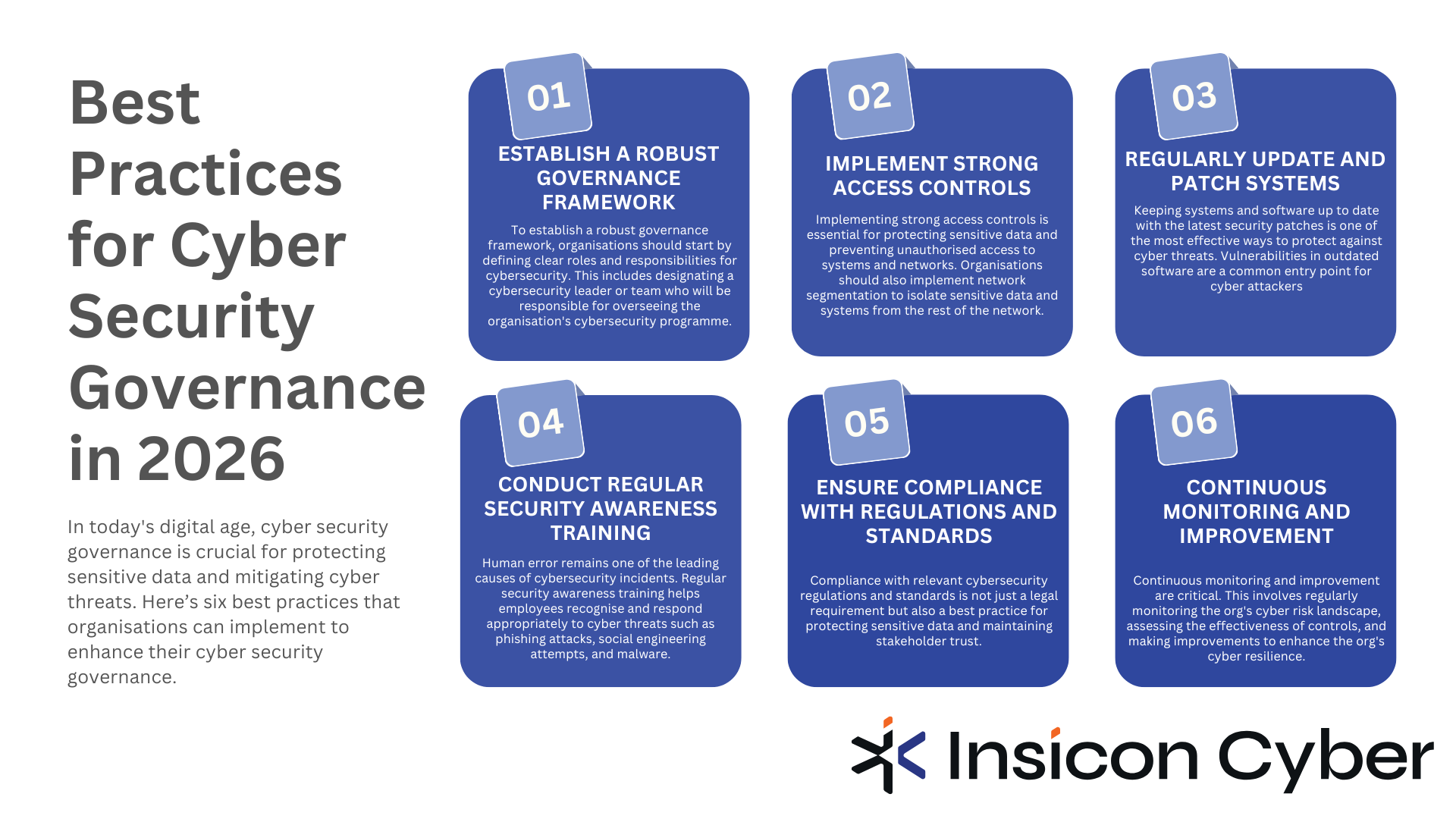
Discover the essential best practises for cybersecurity governance in 2026 to protect sensitive data and ensure compliance with evolving regulations.